
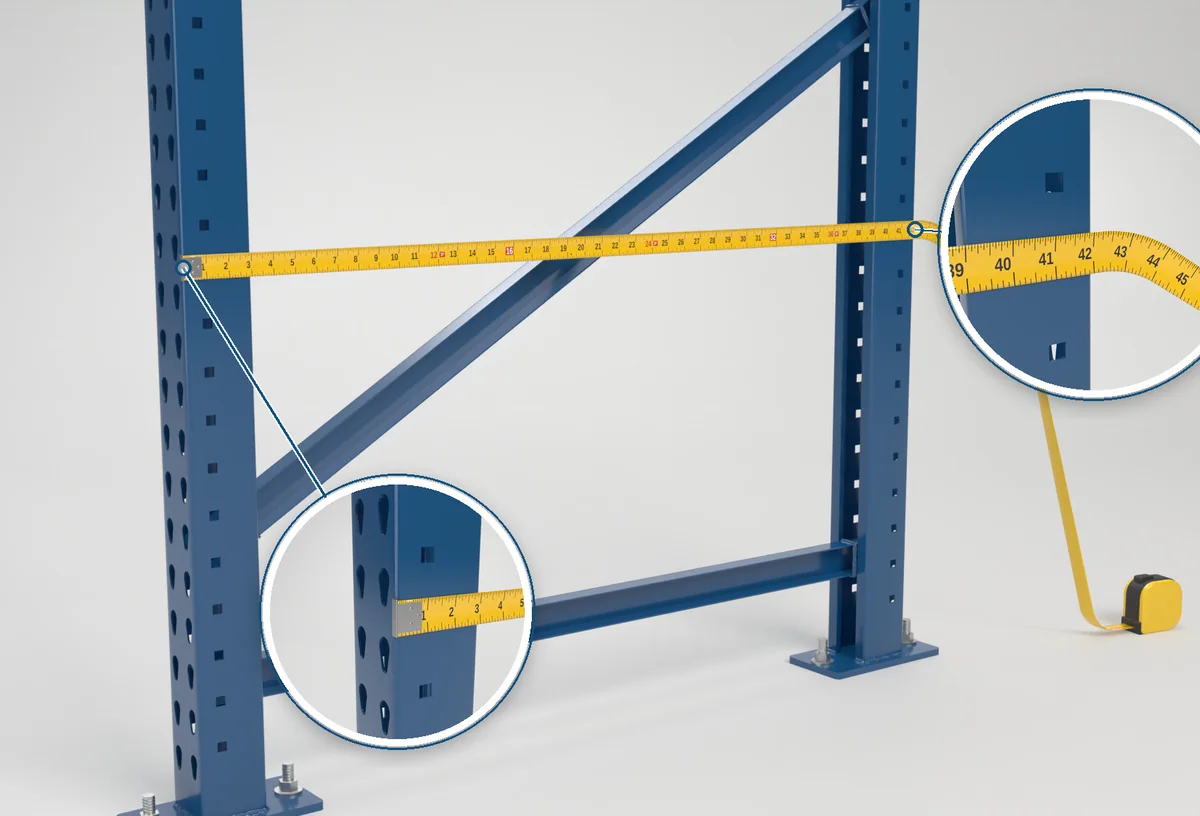
Seven Numbers Describe a Rack
Give a supplier seven numbers and they can quote, match or buy your racking: upright height, upright depth, beam length, beam face height, style (hole pattern), number of levels and number of bays. You need a tape measure and a phone camera. Measure in inches.
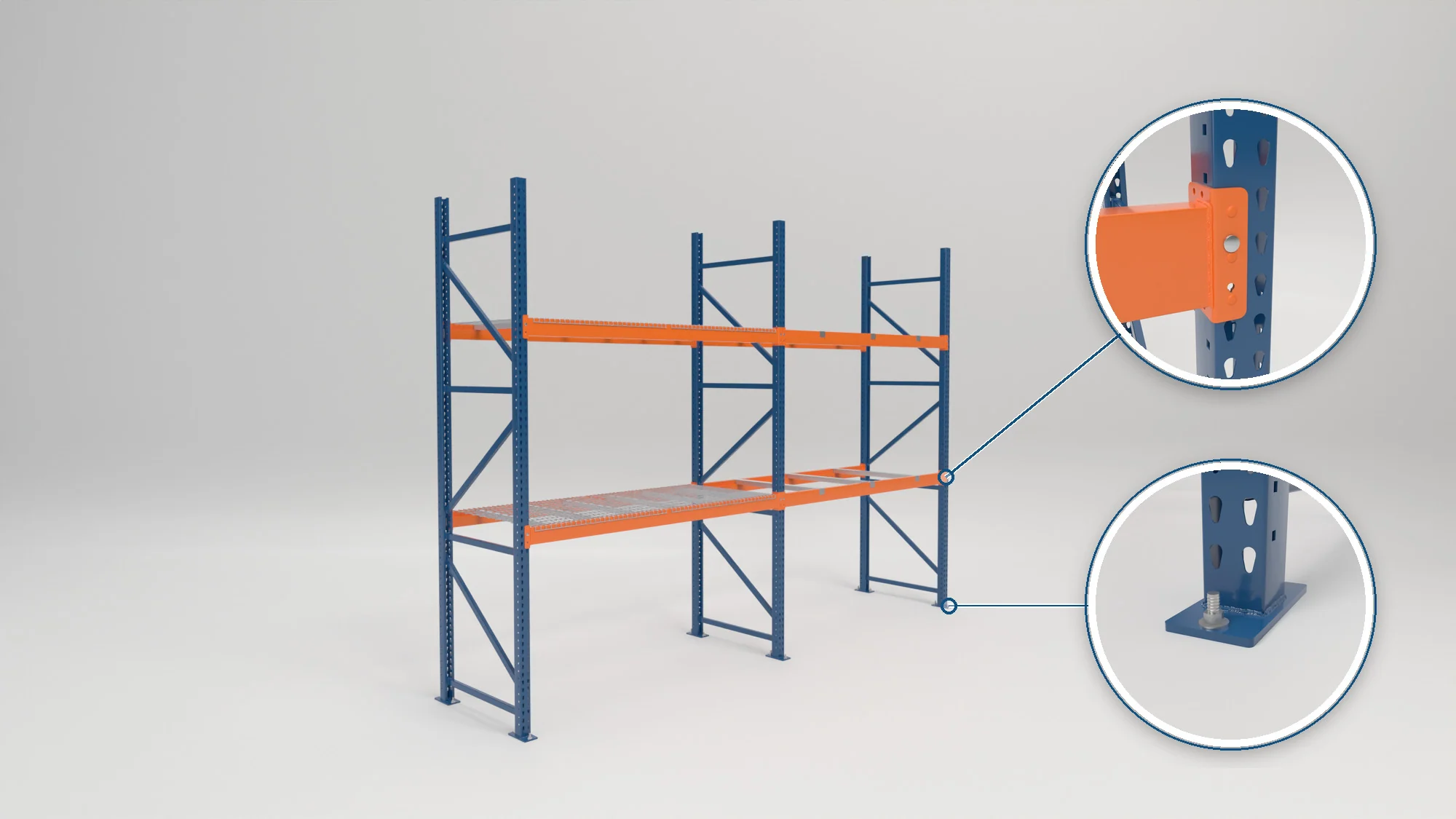
Uprights (Frames)
The upright is the frame at each end of a bay: two columns braced together.
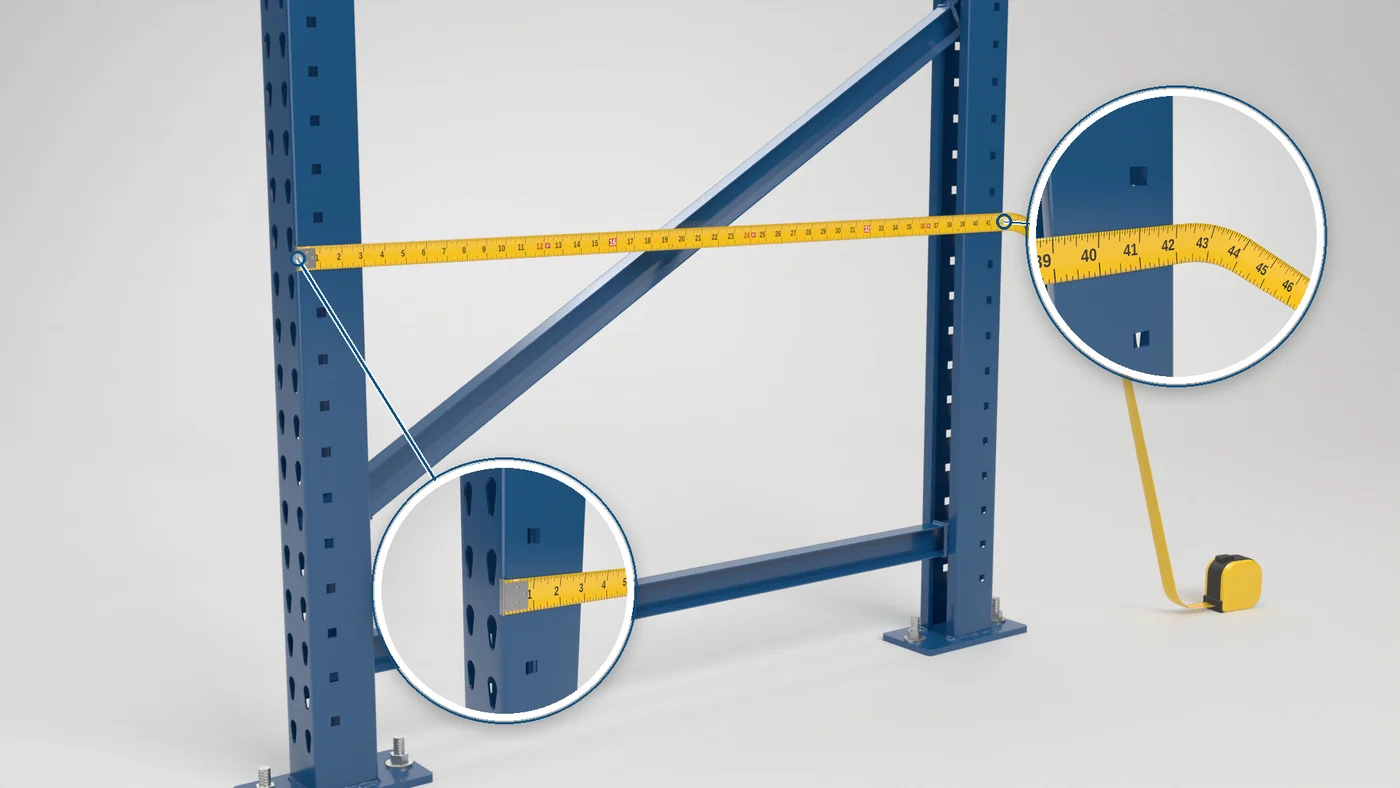
Upright Depth
Hook the tape on the outside of the front column. Read it at the outside of the rear column.
Common: 36", 42", 44", 48". A 48" deep pallet sits on a 42" frame.

Upright Height
Measure from the floor to the top of the column.
Common: 8', 10', 12', 14', 16', 20', 24' (96", 120", 144"...).
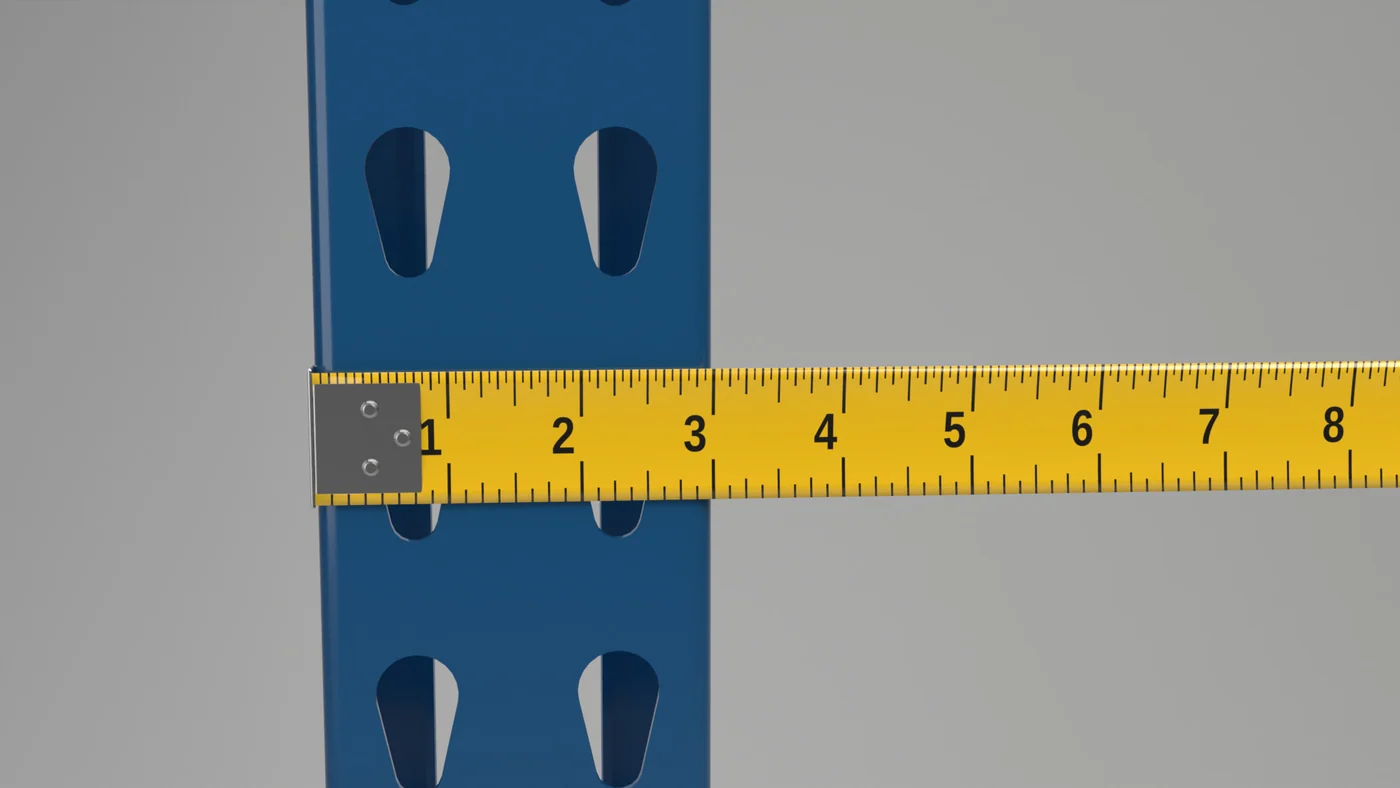
Post Width
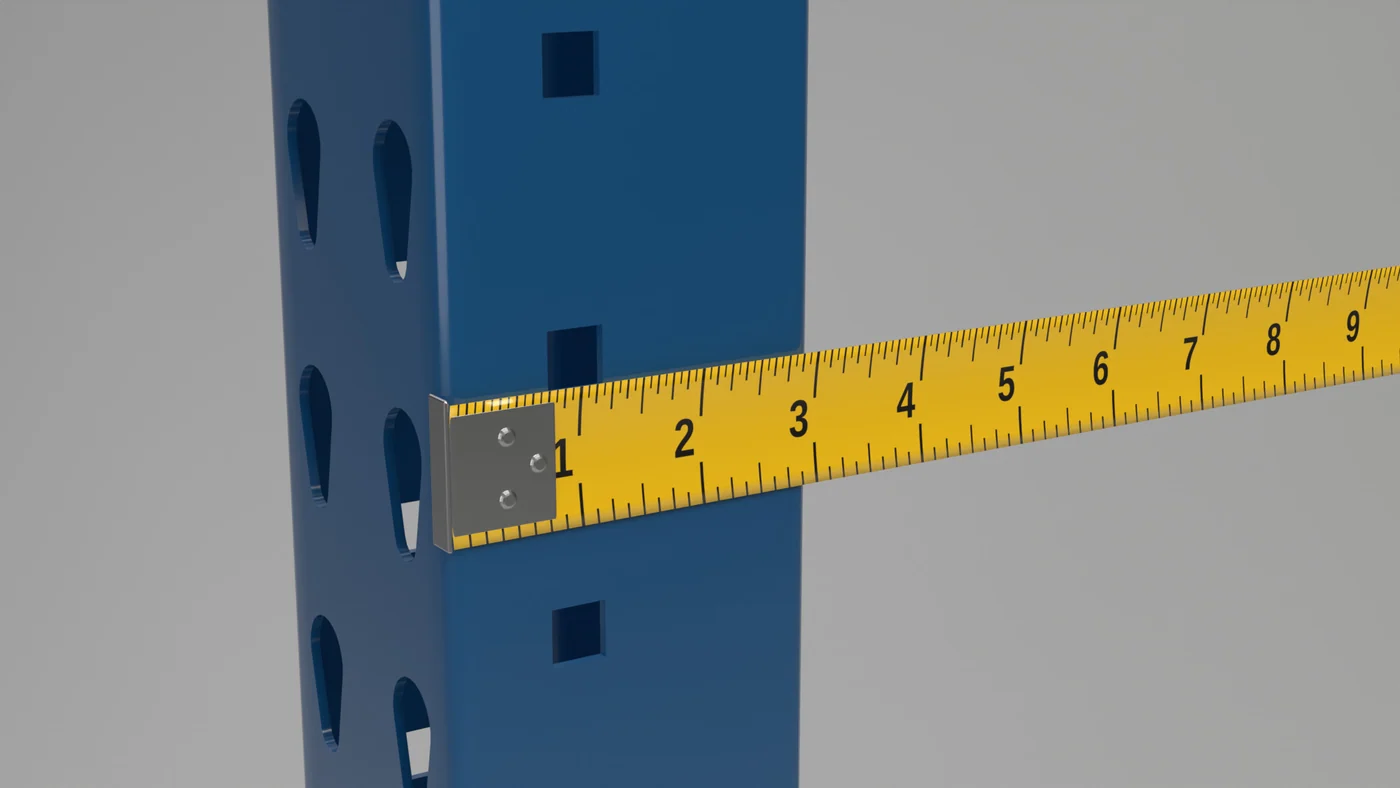
Measure straight across the front face of one column.
Common: 3" on teardrop. 3 5/8" and 4" also exist.
Post Depth
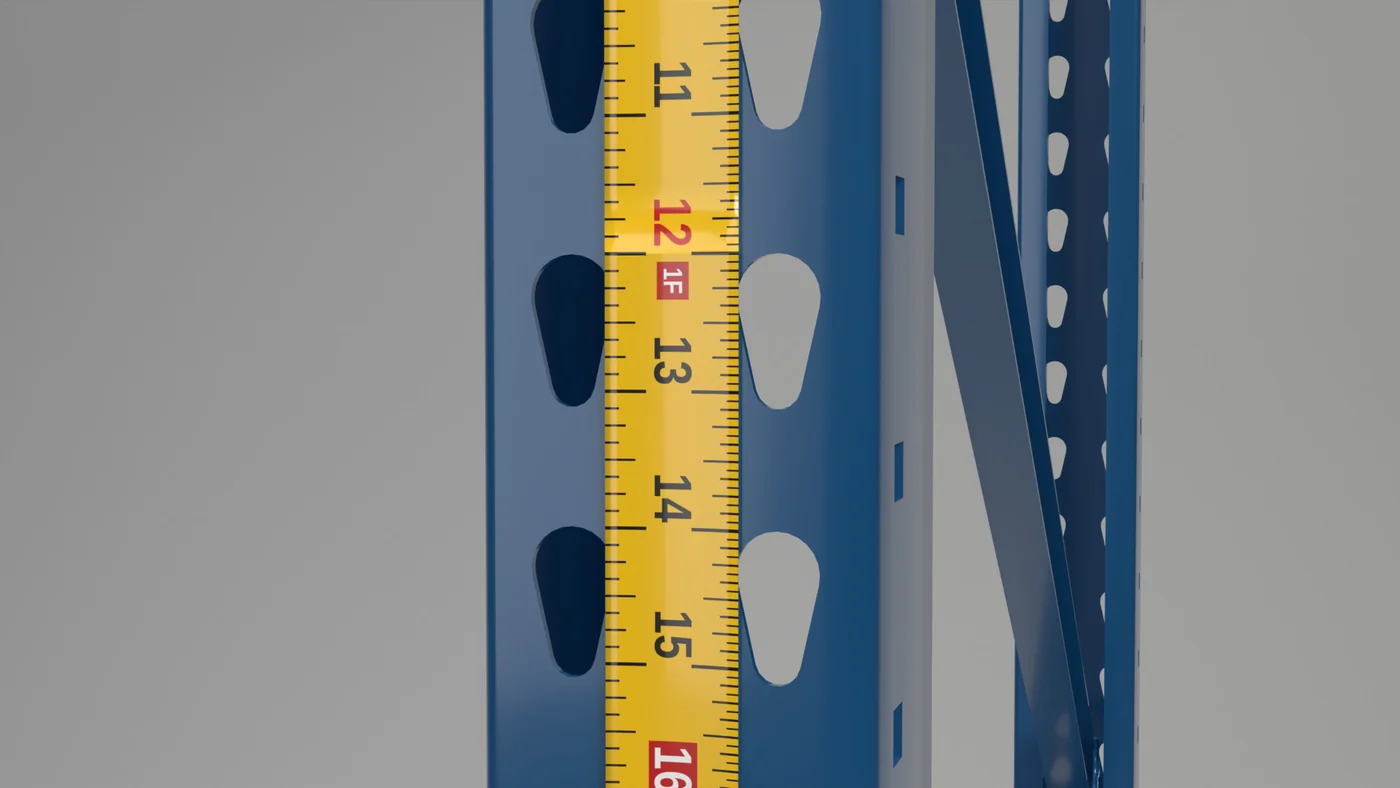
Measure the side of the column, from front to back.
Hole Pitch
Lay the tape along the holes. Measure from the top of one hole to the top of the next.
Teardrop on 2" centres is the most common. Identify your style.
Beams
Beams come in pairs, one front and one back. Each pair is one level.
Beam Length
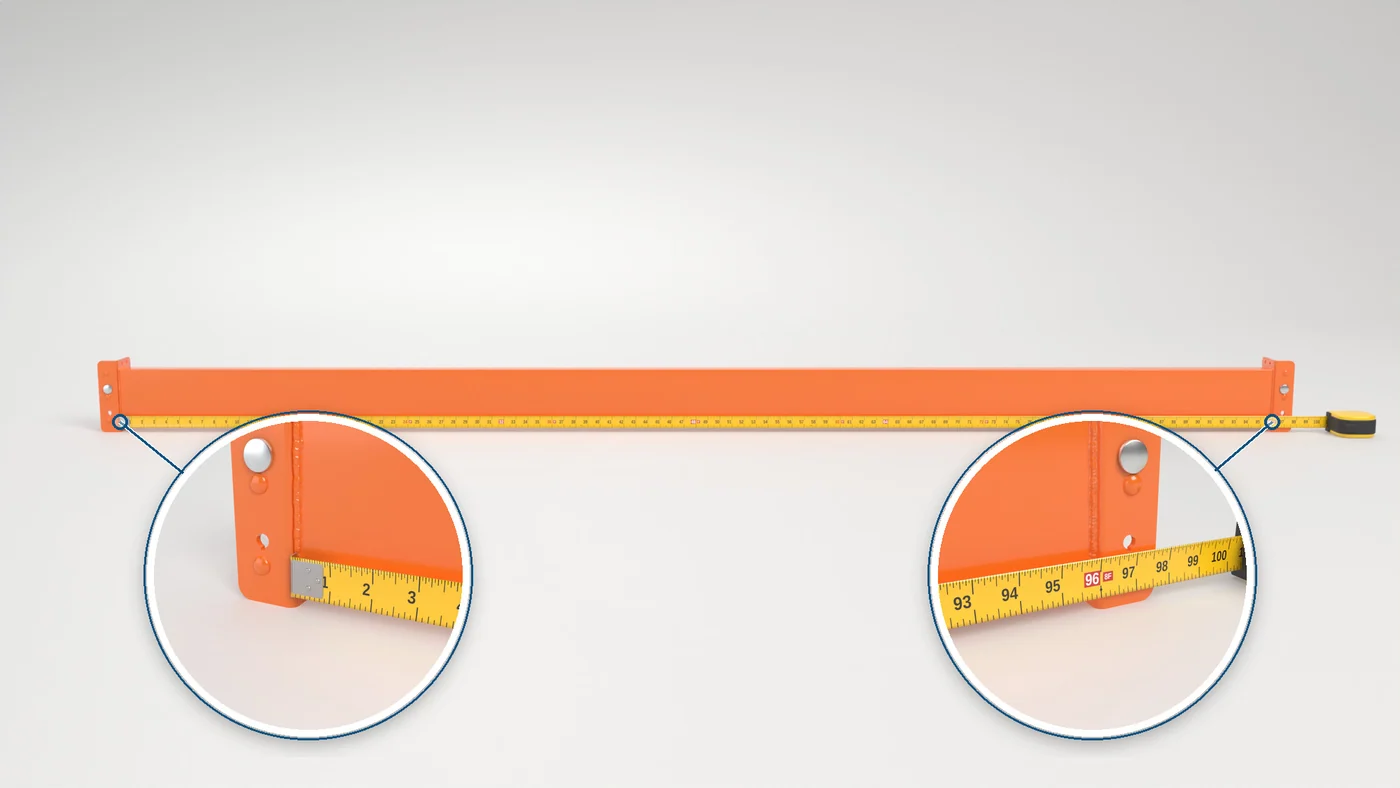
Measure inside the connector plates, from one column face to the other. This is the clear bay width.
Common: 96", 108", 120", 144".
Beam Face Height
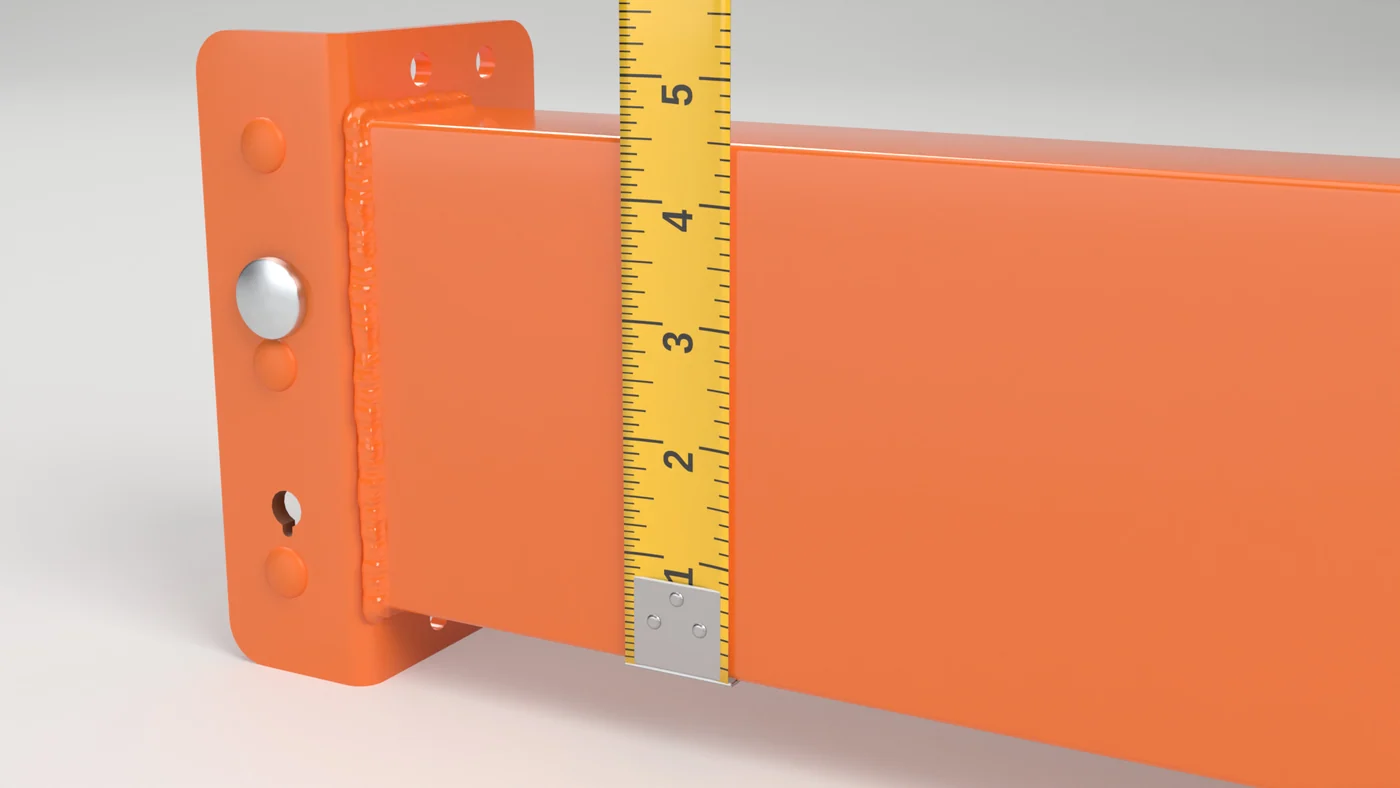
Measure the front wall of the beam, top to bottom. A taller face carries more.
Common: 3" to 6".
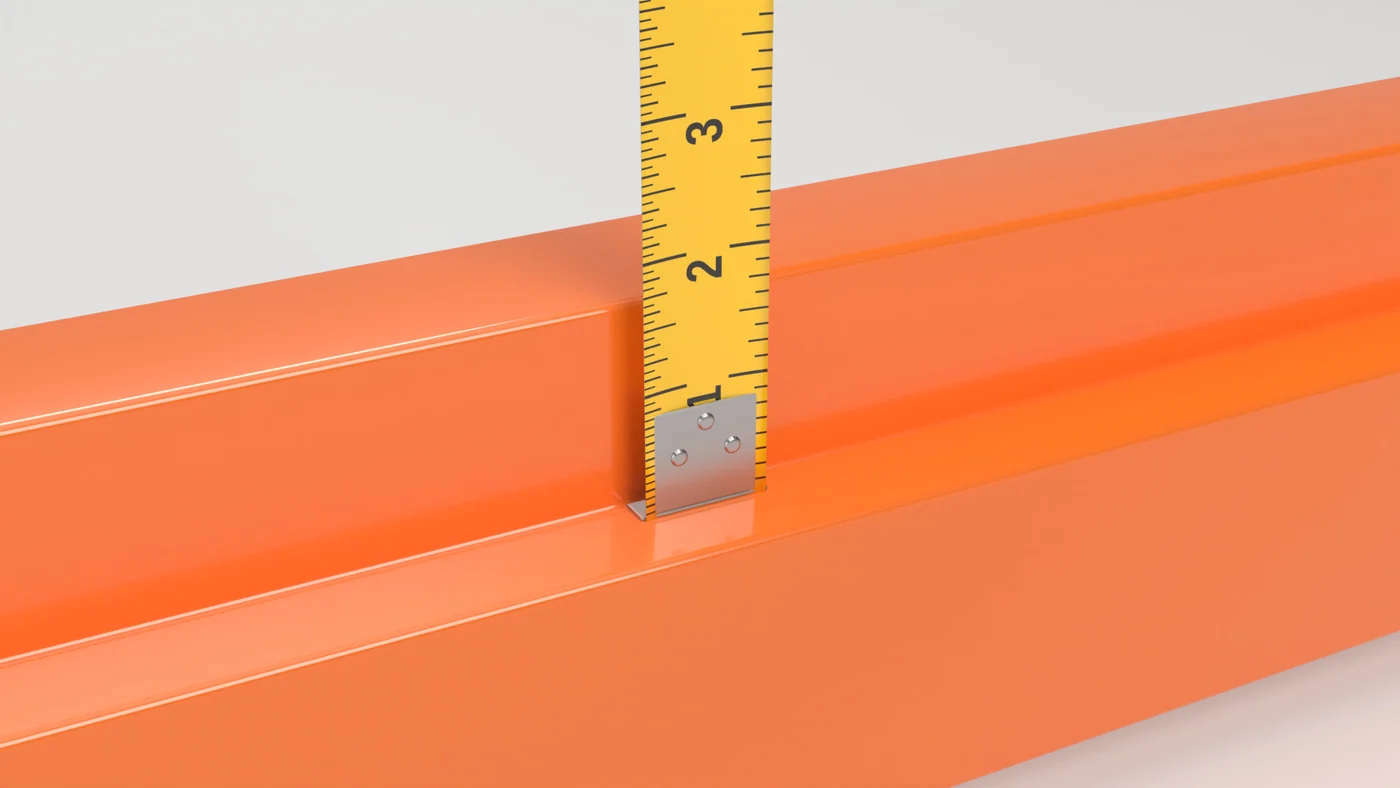
Beam Step
Measure the ledge on the inside top edge, where the deck sits. No ledge means a box beam.
See beam types.
Wire Decks
Decks sit on the beams. Two decks fill a 96" bay.
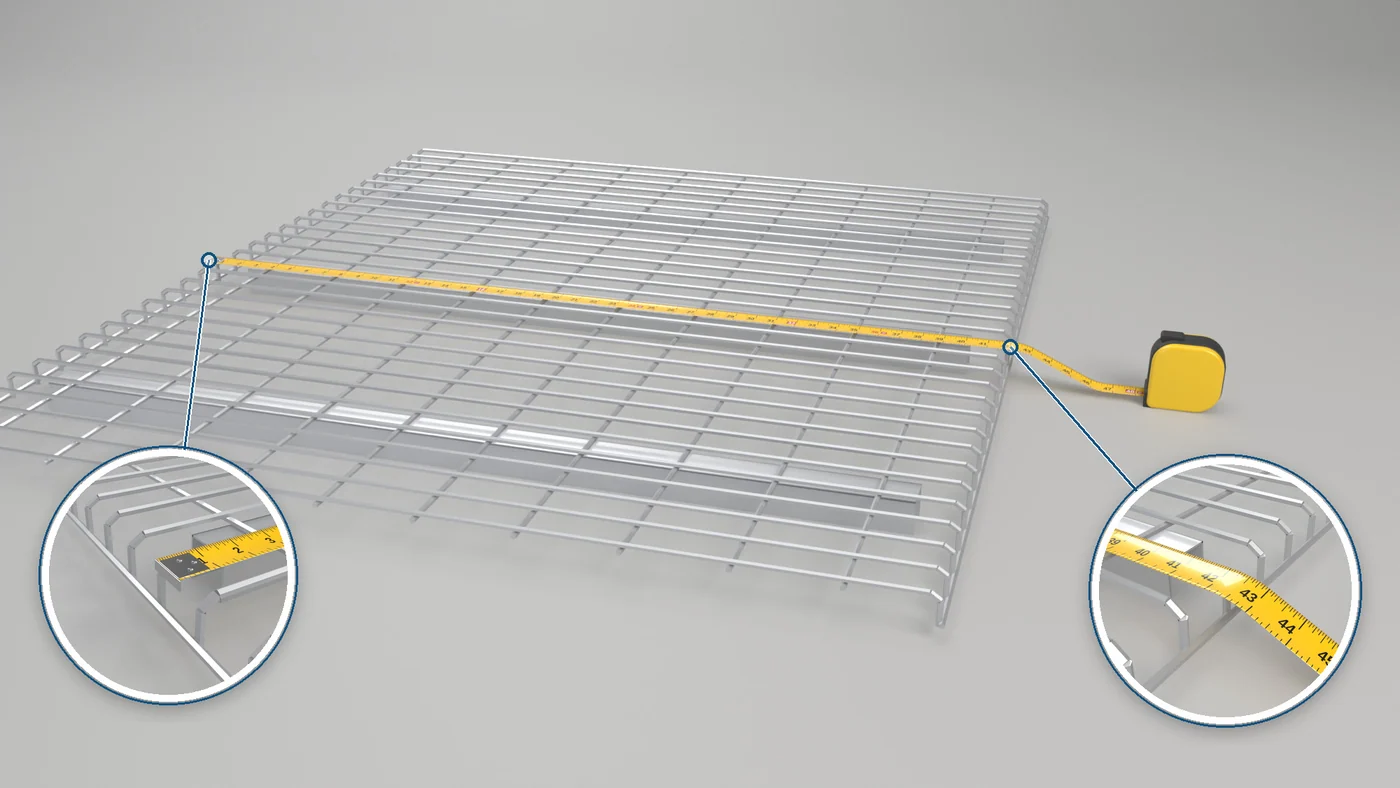
Wire Deck Depth
Measure the deck from front to back. The order size is nominal, usually the frame depth; a tape over the waterfalls can read different.
A 42" deck goes on a 42" frame.
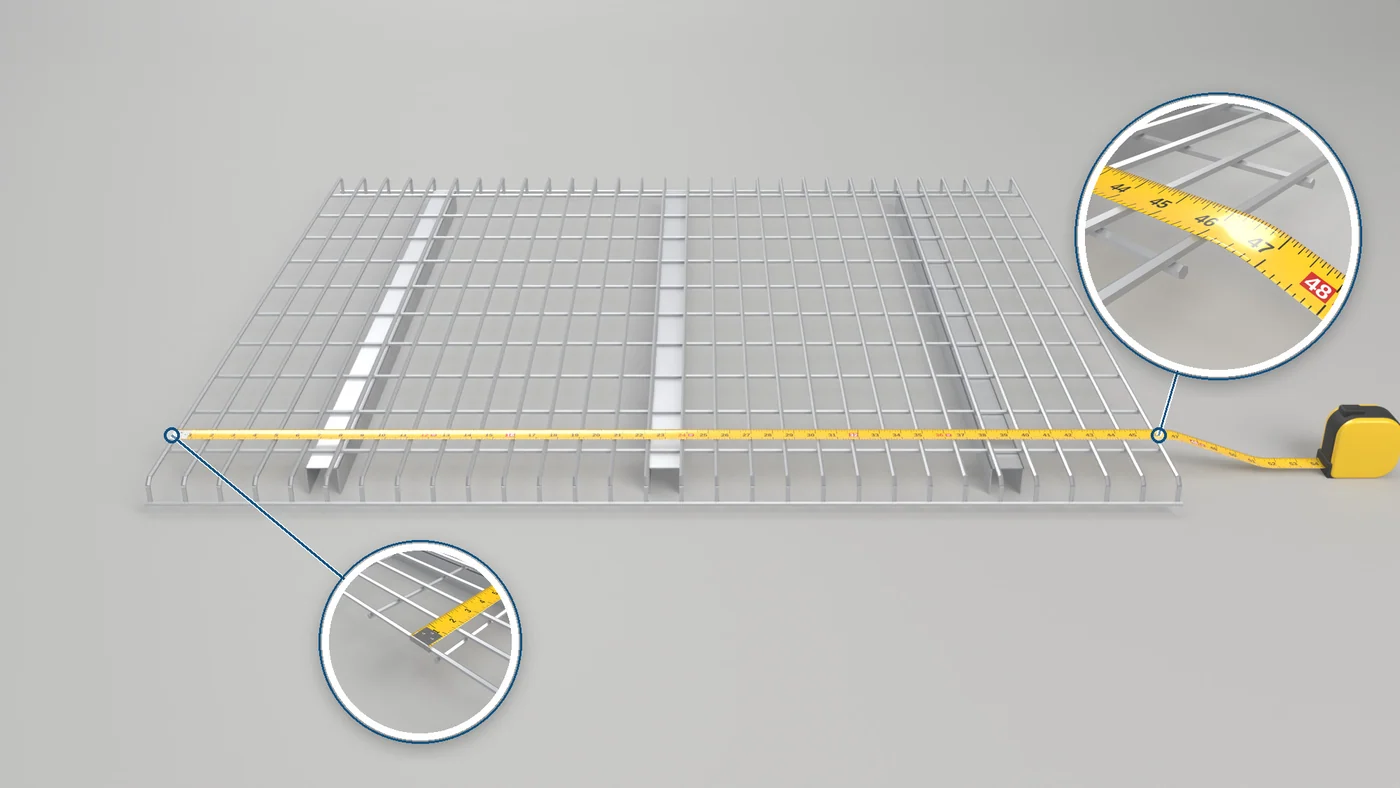
Wire Deck Width
Measure the deck from side to side.
46" for a 96" beam, 52" for 108", 58" for 120".
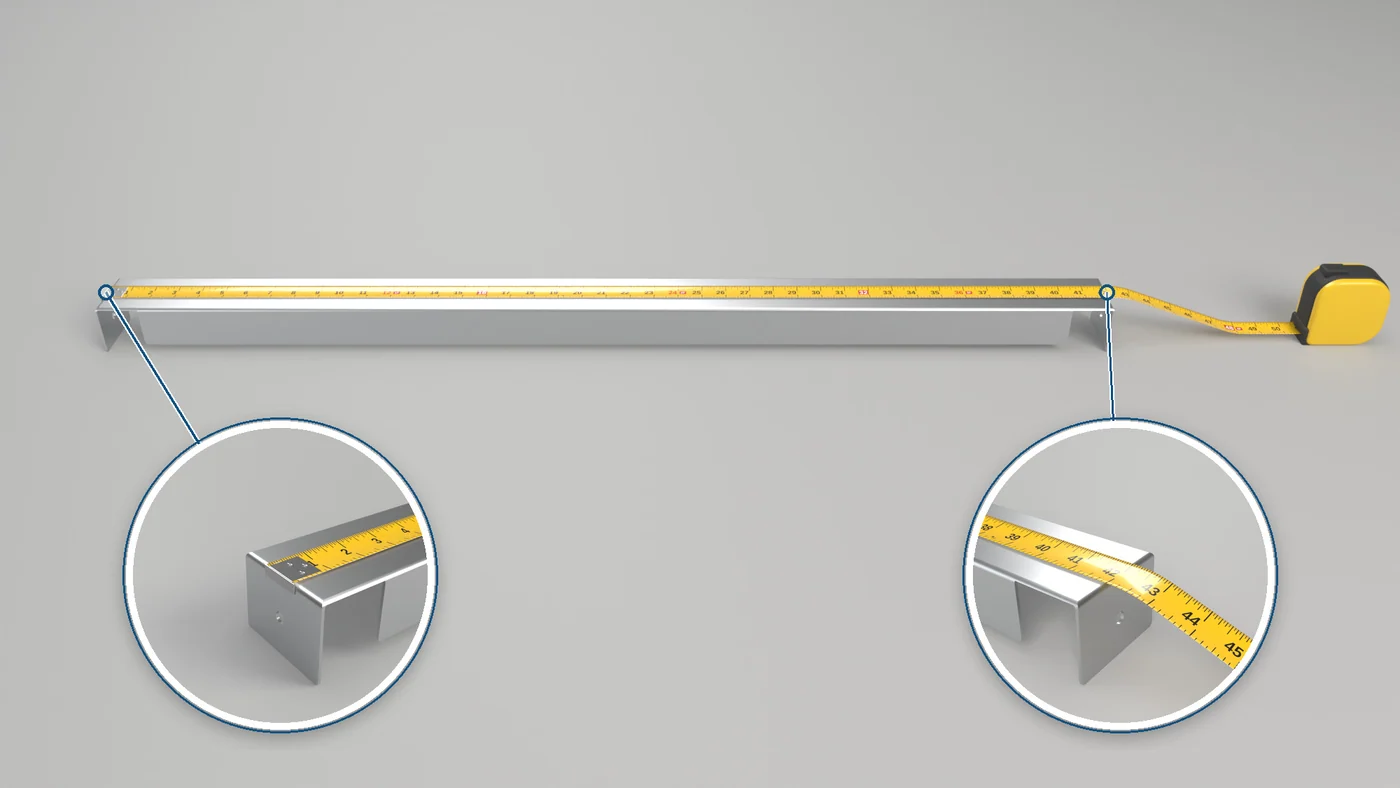
Pallet Support Length
Measure the support bar from end to end. It drops between the beams under a pallet.
Row Spacers
Back-to-back rows are tied together by row spacers.
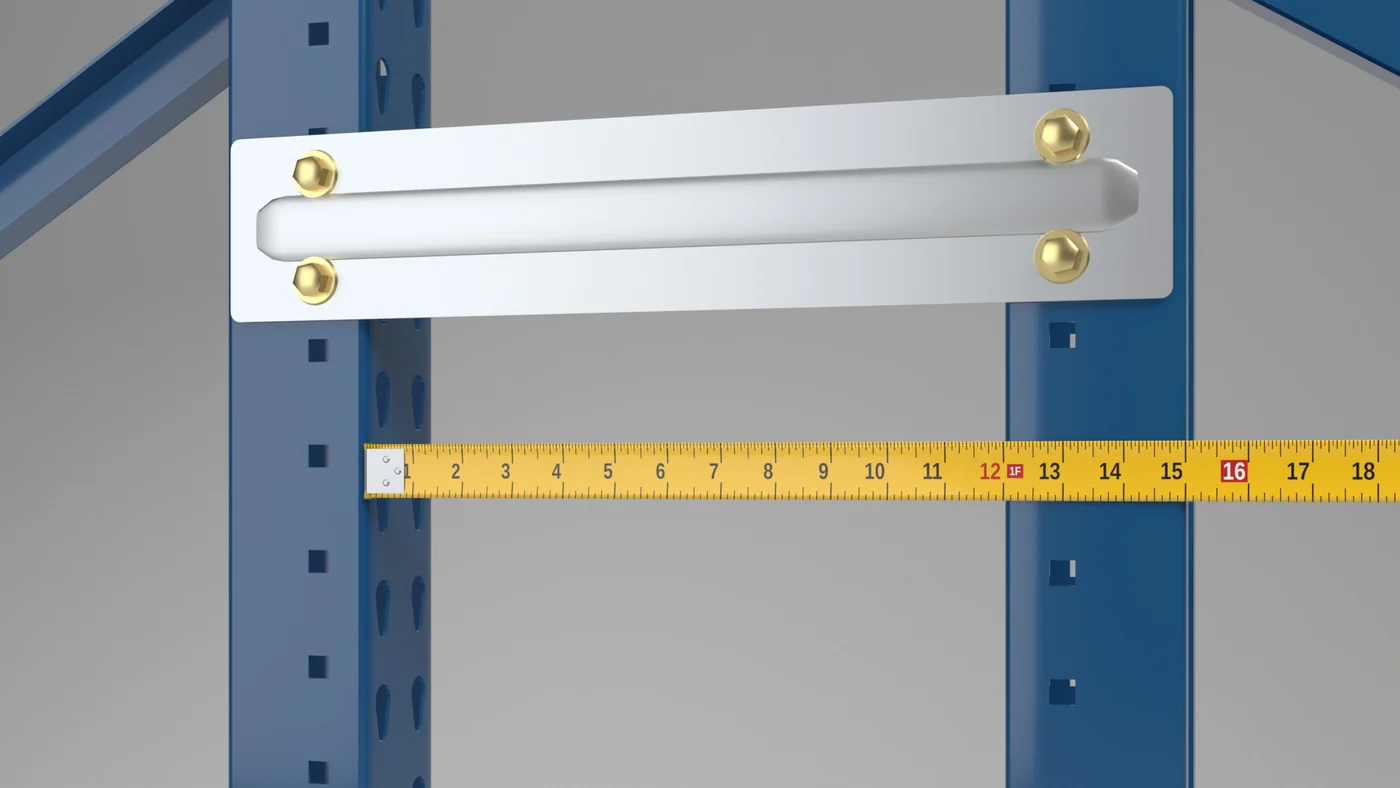
Row Spacer
Measure the gap between the two back-to-back frames the spacer holds.
Usually 6" to 12".
Bays, Levels and Rows
- A bay is the space between two uprights: beam length plus one column (a 96" beam makes a 99" bay centre to centre).
- A beam level is one beam pair. Floor storage is one more level, if you use it.
- Pallet positions = bays x levels x pallets across per level (usually 2 across on 96" beams, 3 across on 144").
- Across vs deep: across is side by side on the beams; deep is one behind another from the aisle.
- Beam spacing: pallet height + about 6" lift clearance + beam face. A 48" load on a 4" beam wants levels about 58" apart.
Aisles and Clearances
- Aisle width is set by the truck: 12 to 13 ft sit-down counterbalance, 8.5 to 10 reach truck, 5.5 to 6.5 turret truck. Use the aisle calculator.
- Clear height: floor to the lowest obstruction (joists, ducts, sprinkler deflectors). Keep the top of the load below the deflectors by the clearance your sprinkler design requires; ESFR heads often need more than standard heads. The rack height calculator takes that number.
- Flue space: 6" between pallets in a bay and 6" between back-to-back rows is common; your fire design sets it.
- Overhang: a 48" pallet on a 42" frame overhangs 3" past each beam face.
The Words
| Term | Meaning |
|---|---|
| Upright / frame | The vertical end assembly: two columns braced together |
| Column / post | One vertical member of the frame |
| Beam / load beam / cross beam | The horizontal member pallets sit on |
| Beam face | The height of the beam's front wall, not the width the pallet bears on |
| Bay / opening | The space between two uprights |
| Level / shelf | One pair of beams |
| Pallet position | One pallet's spot on a level |
| Starter / adder | A starter bay has two uprights; an adder shares one with the next bay |
| Row spacer / back tie | A bar holding two back-to-back frames at a set gap |
| Footplate / base plate | The plate at the bottom of a column that is anchored |
| Anchor | The wedge bolt through the footplate into the slab |
| Wire deck | Welded mesh on channels laid on the beams |
| Pallet support | A bar dropped between beams under a pallet instead of a deck |
| Safety lock / clip | The pin or clip that keeps a beam from lifting out |
| Column guard / protector | Steel guard at the base of a column |
| Flue space | The gap between loads or rows for sprinkler water |
| Teardrop | The slot shape of the most common rack style |
Full list: glossary.
Photograph a column face with a tape across it, a beam end and any label. We confirm the style and sizes the same day, and make an offer if you are selling.
Common questions
How do I measure a pallet rack beam?
Length between the connector plates, face height of the front wall, and step or box. Photograph the connector to identify the style.
What depth upright do I need for a 48 inch pallet?
42 inches. The pallet overhangs 3 inches front and back, which keeps the load on the beams.
How far apart should beam levels be?
Pallet height plus about 6 inches of lift clearance plus the beam face: about 58 inches for a 48 inch load on a 4 inch beam. Frame capacity depends on this spacing.
What is a starter bay and an adder bay?
A starter is a complete bay with two uprights and beams. An adder adds one upright and beams, sharing the other upright with the bay beside it. A row of 10 bays is 1 starter and 9 adders: 11 uprights.


