

How Push-Back Works
Each lane has inclined rails with nested carts. The forklift pushes each new pallet against the last; pick the front and the stack rolls forward. One aisle, last in, first out.
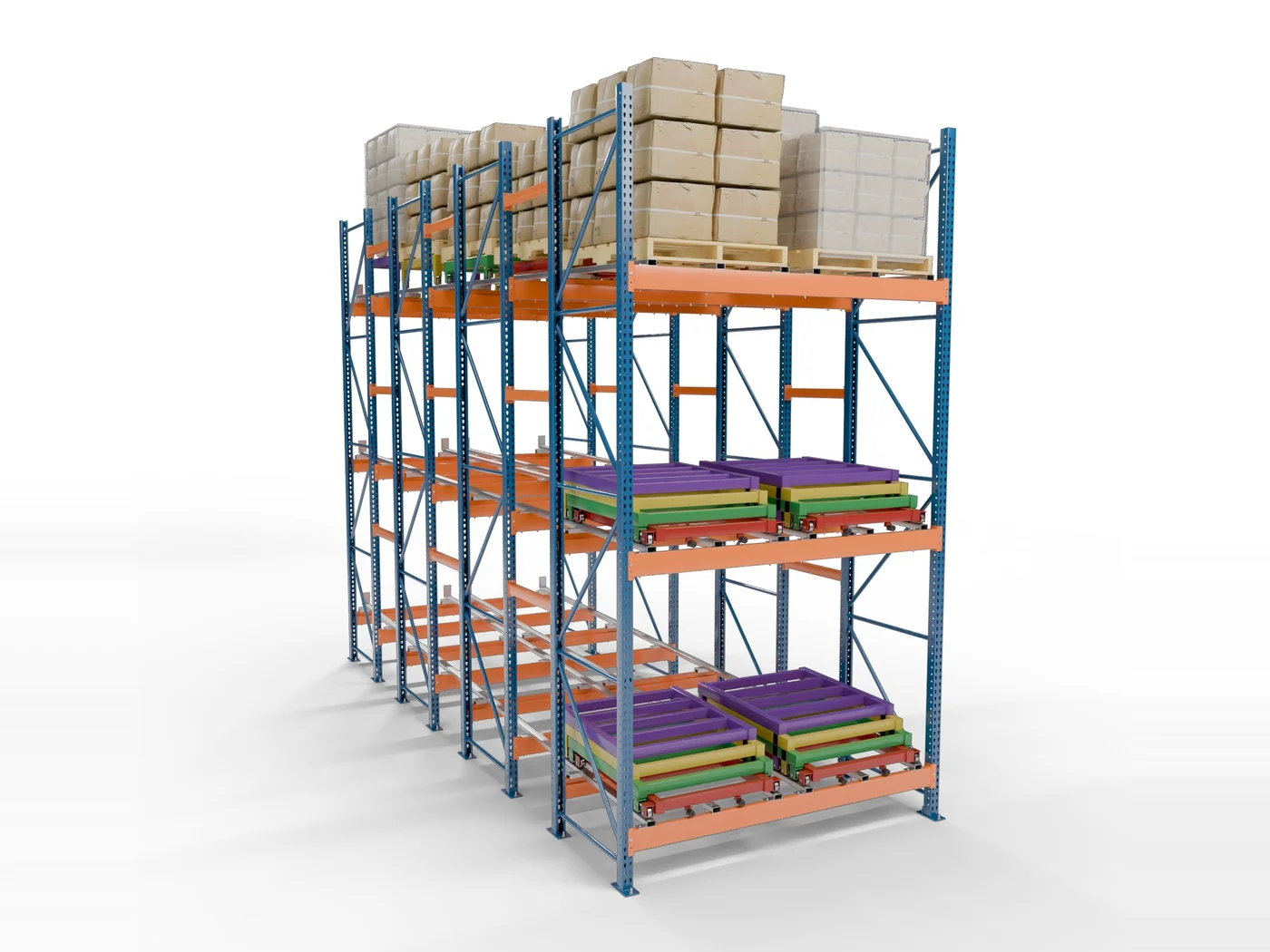
Sizes and Capacities
| Item | Typical |
|---|---|
| Lane depth | 20' 6" to 21' |
| Rail slope | 3/8" per foot (about 8" of rise over the lane) |
| Pallets per lane per level | 5 |
| Cart capacity | 2,500 to 3,000 lb each |
| Levels | 3 to 4; the nested carts add height, per the maker's drawing |
| Truck | Counterbalance or reach truck with the lift, capacity and push the maker specifies |
Where 5-Deep Fits
- Five to ten pallets per SKU, few SKUs: beverage, bottled water, packaging, cold storage.
- Replacing 5-deep drive-in.
- Long, narrow buildings.
What to Watch
- The push: four pallets uphill needs a strong truck.
- Honeycombing: more SKUs than lanes, use 4-deep or 3-deep.
- The floor: we shoot it before quoting.
- Dated product: for FIFO, use pallet flow.
Common questions
How many pallets does a 5-deep push-back hold?
Five per lane per level. A 4-level lane holds 20; ten bays of two lanes hold 400.
Is 5-deep push-back better than drive-in?
For most, yes: a SKU per lane and level, no truck in the rack. Drive-in is cheaper per position and goes deeper.
Do I need a special forklift for 5-deep push-back?
No, if it reaches the top level and can push four loaded pallets.
Is 5 deep the limit for push-back?
No. Common systems run two to six deep, depending on the maker. Past that, pallet flow or a pallet shuttle.


