
One Warehouse, Twelve Ways to Store It
Every storage system trades the same three things against each other: how many pallets fit in the building, how fast you can reach any one of them, and what it costs. Pick the wrong one and you pay for it every day, in wasted floor, slow picking or damaged rack. Here is what each system is, what it is for, which truck it needs and where it goes wrong.
Selective Pallet Racking
What it is. The standard rack you see in most warehouses. Upright frames (the vertical end frames) hold pairs of horizontal beams, and each pallet sits on two beams, one pallet deep, facing an aisle.
Best for. Operations with many SKUs (each distinct product you stock) and only a few pallets of each. Distribution, wholesale, manufacturing raw materials, third-party logistics. If you are not sure what you need, this is the safe default.
Forklift. Almost any truck works. A sit-down counterbalance forklift (the common warehouse forklift with the weight at the back) needs wider aisles. A reach truck, which slides its forks forward to reach into the rack, works in narrower aisles and gets more rows in the same building.
Rotation. Your choice. Every pallet is reachable, so you can run first in, first out (oldest pallet leaves first) or any order you like.
Watch out for. It uses the most floor per pallet, because every row needs its own aisle. The uprights at the aisle take forklift hits every day, so budget for column guards and end-of-row protectors, and replace damaged frames instead of living with them. Post the load rating on every bay and do not mix beams and frames from different manufacturers without an engineer signing off.
Double-Deep Racking
What it is. Selective rack two positions deep, so each bay holds a pallet in front and a second pallet behind it, all worked from one aisle.
Best for. Products you hold at least two pallets of at a time. Beverage, packaging, building products, food distribution. You gain storage by removing every other aisle.
Forklift. A double-deep reach truck, which has extending forks (often a scissor-type mechanism) long enough to reach the second pallet. A standard reach truck or counterbalance cannot reach the back position.
Rotation. Last in, first out within each bay. The back pallet only comes out after the front one moves.
Watch out for. The truck is a real added cost and your operators need training on it, because placing a pallet at full reach and height is harder to see. Mixing different products front and back means double handling. Run it only where the product mix supports two pallets per item.
Drive-In Racking
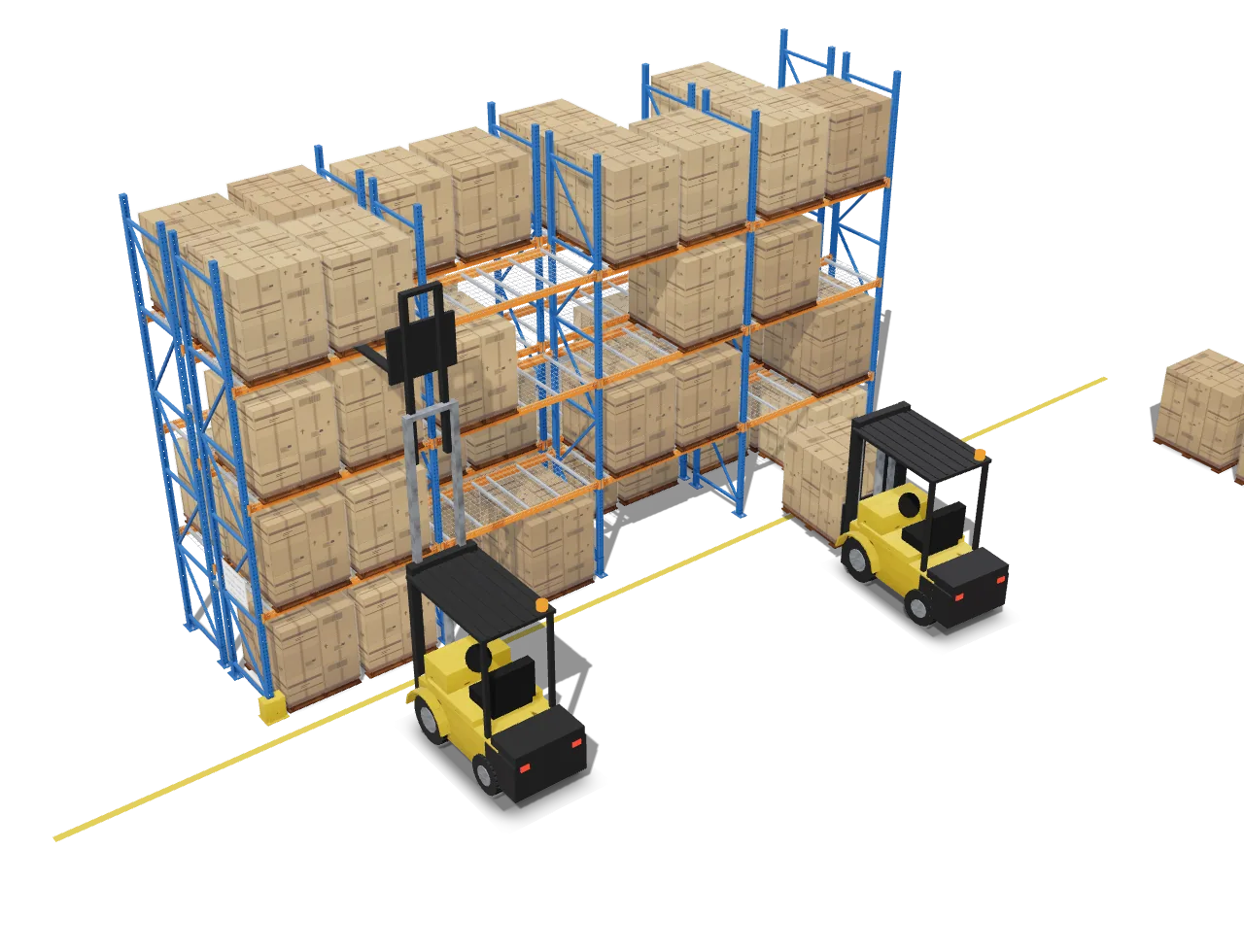
What it is. A block of rack with no beams across the front. The forklift drives into a lane and sets each pallet on rails that run along both sides of the lane. Pallets stack deep into the block, one behind the other.
Best for. Large quantities of a small number of products. Frozen and cold storage, beverage, seasonal goods, raw materials. It is the classic freezer rack because it packs the most product into expensive cold space.
Forklift. A counterbalance forklift or a reach truck that fits inside the lane with room on each side. The mast and overhead guard have to clear the rails at every level.
Rotation. Last in, first out. You load and unload from the same face, so the first pallet in is the last one out.
Watch out for. Rack damage. The truck drives between the uprights, and hits inside the lanes are common and hard to spot, so inspect often and install floor guide rails at the lane entries. Each lane should hold one product only, and a lane that is half empty cannot take anything else. That wasted space is called honeycombing, and it is the main reason drive-in disappoints when the product mix is too wide. Pallets sit only on their edges, so broken or weak pallets are a hazard.
Drive-Through Racking
What it is. Drive-in rack open at both ends. You load from one side and pick from the other.
Best for. High volume of few products where the oldest stock must ship first. Food, dairy, anything with an expiration date. Also useful as a buffer between production and shipping, when one team loads and another team unloads.
Forklift. Same as drive-in: a counterbalance or reach truck that fits inside the lane.
Rotation. First in, first out. The forklift loads from one aisle and picks from the other, so the oldest pallet in each lane comes out first.
Watch out for. You give up an aisle at the back, so it holds less than drive-in in the same footprint. With no closed back, the rack depends on its top ties and bracing for stability, so it must be engineered and installed as one system. All the drive-in warnings about lane damage, honeycombing and pallet quality apply here too.
Push-Back Racking
What it is. Each lane holds several pallets on nested carts that ride on rails sloping gently down toward the aisle. Loading a new pallet pushes the ones in front of it back. Take the front pallet out and the rest roll forward to the aisle on their own.
Best for. Medium and high volume products with several pallets each, when you want more density than selective without driving into the rack. Grocery, beverage, consumer goods, and cold storage.
Forklift. Any standard counterbalance or reach truck. The truck never enters the rack, which keeps rack damage down and makes it easier on operators than drive-in.
Rotation. Last in, first out, per lane.
Watch out for. It costs more than selective because of the carts and rails. Pallets should be in good condition and loaded weights reasonably consistent, so the carts roll smoothly. Keep one product per lane, inspect the carts and rails on a schedule, and remember the carts take up some height at each level.
Pallet Flow Racking
What it is. Deep lanes fitted with gravity rollers on a slight slope. Pallets go in at the high end and roll down to the pick face at the low end. Brakes along the lane control the speed, and a separator at the front holds back the next pallet while the first is removed.
Best for. High volume products where rotation matters. Food and beverage, pharmaceuticals, anything dated. Also a strong fit for staging orders near shipping docks and for feeding production lines.
Forklift. Standard counterbalance or reach trucks, one working the loading aisle and one working the pick aisle. Loading and picking never get in each other's way.
Rotation. First in, first out, per lane. The oldest pallet in each lane is at the pick face.
Watch out for. Pallet quality makes or breaks this system. Pallets need sound bottom boards that run in the direction of the rollers, and loads in a consistent weight range, or they jam and stall. It is one of the most expensive systems per pallet and needs an aisle on each side. Freezer use is possible, but the rollers and brakes must be rated for the cold.
Shuttle Racking
What it is. A deep-lane system served by a battery-powered cart, the shuttle, that runs on rails under the pallets. The forklift sets a pallet at the lane entrance, and the shuttle carries it in to the deepest open spot and brings pallets back out when called.
Best for. High volume of few products, especially in freezers and cold storage, where drive-in density is needed but you want faster cycles and less damage.
Forklift. A standard counterbalance or reach truck to set pallets at the lane and to move the shuttle from lane to lane. The operator controls the shuttle remotely and never drives into the rack.
Rotation. Either. Load and unload from the same side for last in, first out, or from opposite sides for first in, first out.
Watch out for. Higher upfront cost than drive-in, plus shuttles and batteries to buy, charge and maintain, and cold shortens battery life. Pallets must be in good condition and consistent in size. You still want one product per lane.
Very Narrow Aisle Racking
What it is. Selective rack built tall with aisles much narrower than a normal forklift needs. Often called VNA.
Best for. Many SKUs where every pallet must stay reachable but floor space is tight and the building has height. Third-party logistics, parts distribution, retail distribution.
Forklift. A turret truck. Its forks rotate to put away on either side without the truck turning in the aisle. In many models the operator rides up with the load. The truck runs on a guidance system, either a wire buried in the floor or rails mounted along the aisle, that steers it straight down the aisle. You also need a standard truck to bring pallets to and from the end of the aisles.
Rotation. Your choice. Every pallet is reachable.
Watch out for. The floor. VNA needs a very flat, level slab, and many existing floors need grinding or a new slab before the trucks can run at height safely. The trucks are expensive and slow outside their aisles. The rack must be set plumb and square to tight tolerances. Tall storage also brings sprinkler and fire code requirements, so check with your fire marshal early.
Cantilever Racking
What it is. Steel columns with arms sticking out, and no posts across the front. Long loads lie across the arms without anything in the way.
Best for. Lumber, pipe, tubing, bar stock, sheet goods, furniture and other long or awkward items. Lumber yards, metal service centers, building supply. Single-sided against a wall or double-sided in the open, and available galvanized for outdoor yards.
Forklift. A counterbalance forklift for shorter loads. For long material, a sideloader (a truck that carries the load sideways along its body) or a four-way truck that can drive sideways lets you work narrower aisles safely.
Rotation. Your choice. Everything is visible and reachable.
Watch out for. Arm capacity and spacing. The load has to rest on enough arms to stay supported without sagging, and must not hang far past the end of the arms. Size the arms for your heaviest bundle, not the average one.
Pick Modules
What it is. A multi-level structure built from rack, with walkways on each level. It combines carton flow (sloped roller shelves that feed cases to the picker), pallet flow and shelving, usually with a takeaway conveyor on each level carrying picked orders out.
Best for. High volume case and piece picking. E-commerce, retail store replenishment, pharmaceutical and parts distribution. Anywhere many people pick many small orders every day.
Forklift. Forklifts replenish from the back, loading pallet flow lanes or full cases. Pickers walk the front and never work beside a forklift, which is both faster and safer.
Rotation. First in, first out, built in through the flow lanes.
Watch out for. Permits and fire code. The walkways count as occupied floors, so expect sprinklers under them, code-compliant stairs, railings and exits, and a building permit. The design must start from your actual order data, or you build a machine for the wrong job. Leave room to grow.
Mezzanines
What it is. A steel second floor inside your building. Free-standing on its own columns, supported by the rack below, or supported by shelving.
Best for. Doubling usable floor space without moving. Light storage, picking, packing, returns processing and offices above the warehouse floor.
Forklift. A forklift lifts pallets up to a pallet gate, a safety gate that keeps the edge closed while loading. People work upstairs on foot with carts.
Rotation. Not applicable. It is a floor, not a storage method.
Watch out for. It needs a building permit, stairs and exits that meet code, railings, and often sprinklers underneath. Each column puts a concentrated load on your slab, so the floor under it must be checked. Rate the deck for what you will actually put on it.
Conveyors
What it is. Gravity roller, skate wheel and powered belt or roller lines that move cartons without people carrying them.
Best for. Truck loading and unloading, packing lines, pick module takeaway, sorting, and connecting work areas across a building.
Forklift. None. Conveyors replace walking and carrying, not forklifts.
Rotation. Not applicable.
Watch out for. Gravity lines need the right slope and steady carton bottoms to keep product moving. Powered lines need electrical work, controls and guarding. Plan crossovers or gates where people need to get through, and leave space for product to queue up without backing into the work area.
How to Choose
| System | Density | Every pallet reachable? | Rotation | Forklift | Cost compared to selective |
|---|---|---|---|---|---|
| Selective | Low | Yes | Any | Counterbalance or reach truck | Low |
| Double-Deep | Medium | No | Last in, first out | Double-deep reach truck | Low |
| Drive-In | High | No | Last in, first out | Counterbalance or reach truck, drives in | Medium |
| Drive-Through | High | No | First in, first out | Counterbalance or reach truck, drives in | Medium |
| Push-Back | Medium | No | Last in, first out | Counterbalance or reach truck | Medium |
| Pallet Flow | High | No | First in, first out | Counterbalance or reach truck | High |
| Shuttle | High | No | Either | Counterbalance or reach truck plus shuttle | High |
| Very Narrow Aisle | Medium | Yes | Any | Turret truck with guidance | High |
| Cantilever | Low | Yes | Any | Counterbalance or sideloader | Medium |
- Many SKUs, one or two pallets each. Selective, or VNA if the building is tall.
- Many SKUs, several pallets each. Double-deep or push-back.
- Few SKUs, lots of pallets. Drive-in, shuttle, or pallet flow if rotation matters.
- Dated product. Pallet flow or drive-through.
- Long material. Cantilever.
- Case picking at volume. A pick module.
- Out of floor, not out of height. A mezzanine.
Most warehouses end up with more than one system. Fast movers in flow or push-back, the long tail in selective, bulk in drive-in. Start from your product list and your trucks, not from a catalog.
Send us the building and product list for a layout, new and used.


